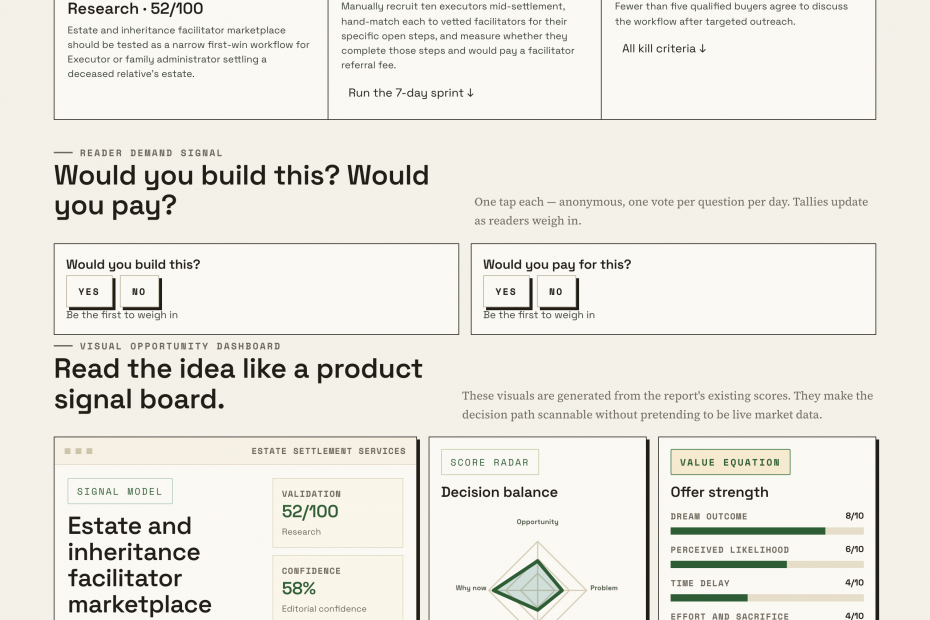
Full opportunity report: Estate And Inheritance Facilitator Marketplace on IdeaNavigator AI — validation score, market gap, and execution plan.
TL;DR
A marketplace for estate and inheritance facilitation is in testing, aiming to simplify estate settlement. It matches executors with vetted facilitators for specific steps, addressing a growing need amid the largest wealth transfer in history.
A new estate and inheritance facilitator marketplace is in the testing stage, focusing on providing a guided workflow for executors and family administrators to settle estates more efficiently. The initiative aims to address the complex, fragmented process of estate settlement, especially as the largest generational wealth transfer in history accelerates.
The marketplace is designed to serve executors and family administrators who often face multiple challenges when settling a deceased relative’s estate, including probate filings, asset appraisals, property cleanouts, and account closures. Currently, most executors manage these tasks only once, without a clear playbook, and must find trustworthy service providers under significant emotional and time pressures.
According to an anonymous researcher involved in the project, the core concept involves a guided intake process that diagnoses the specific steps needed for each estate. It then hand-matches these steps with vetted facilitators for services like legal filings, appraisals, or property management. The process is run as a concierge-style service before any self-serve marketplace is launched, aiming to ensure quality and trustworthiness.
The initial validation plan involves manually recruiting ten executors mid-settlement, matching each to appropriate facilitators, and measuring whether the assigned steps are completed successfully. The goal is to determine if this approach improves efficiency and whether participating executors are willing to pay a referral or success fee to the facilitators.
Implications for Estate Settlement Efficiency
This development could significantly improve the estate settlement experience by providing a structured, trusted pathway for executors, reducing the time and stress involved. It addresses a growing market need as estates become more complex, spanning multiple states and digital assets, and as the volume of estate transfers increases due to demographic shifts.
By creating a vetted network of facilitators and a guided process, the marketplace has the potential to reduce delays, minimize errors, and increase transparency in estate settlement. This could also establish a scalable model for future expansion, transforming how estate services are coordinated and delivered.
Growing Demand Amid Largest Wealth Transfer
The concept emerges amid the ongoing largest generational wealth transfer in history, with trillions of dollars passing between baby boomers and heirs. As estates grow in size and complexity, especially across state lines and digital accounts, the need for specialized facilitation services has increased. Currently, these services are scattered across various directories and providers, with no centralized coordination.
Historically, estate settlement has been a fragmented process, often relying on informal networks or manual coordination. The new marketplace aims to formalize and streamline this process, offering a guided, one-stop approach that could become a standard for estate administration in the future.
“The core idea is to diagnose each estate’s specific needs and then hand-match those needs with vetted facilitators, running the process as a concierge service before a full marketplace launches.”
— an anonymous researcher
Unclear Aspects of Market Adoption and Scalability
It is still unclear how quickly and broadly this guided facilitation model will be adopted by executors and facilitators, or how scalable the approach will be as the market grows. The success of the pilot depends on whether participating executors find the process valuable enough to pay a fee and whether facilitators can meet the demand efficiently.
Additionally, the long-term sustainability of the model and its ability to integrate with existing estate services and digital assets remain to be seen.
Next Steps for Validation and Expansion
The immediate next step involves recruiting ten executors mid-settlement, conducting the matching process, and tracking completion rates and willingness to pay. If successful, the team plans to expand the pilot, refine the platform, and explore broader market integration. Further validation will determine whether this model can evolve into a scalable, full-scale marketplace for estate facilitation services.
Key Questions
What is the main goal of the estate facilitator marketplace?
The main goal is to streamline estate settlement by guiding executors through the process and connecting them with vetted facilitators for each step, reducing complexity and delays.
How will the marketplace validate its effectiveness?
Through manual recruitment of executors, matching them with facilitators, and measuring whether the steps are completed successfully and if executors are willing to pay a fee.
What challenges could this marketplace face?
Potential challenges include achieving broad adoption, ensuring facilitator quality at scale, and integrating digital assets and multi-state estates effectively.
When might this marketplace become widely available?
It is currently in testing; broader availability depends on pilot success and further development, which could take several months to a year.
Will this service replace traditional estate lawyers or firms?
It aims to complement existing services by providing a coordinated facilitation process, not replace legal professionals but streamline their collaboration.
Source: IdeaNavigator AI