TL;DR
Google made Gemini 4 Carbon available to paying developers, businesses and Google AI Ultra subscribers on November 10, alongside a published model card. On the new MKA benchmark, Carbon scored 54.3%, just behind Claude Fable 5.2 at 56.6%; Google DeepMind reported Carbon cost $5.63 per task, compared with $35.28 for Fable.
Google opened Gemini 4 Carbon to paying developers, businesses and Google AI Ultra subscribers on November 10, the same day it released a model card and introduced results from a new benchmark for agents working with visual documents. Carbon ranked second on MKA, behind Anthropic’s Claude Fable 5.2, while Google DeepMind reported a substantially lower cost per benchmark task.
MKA, developed by Google DeepMind and Artificial Analysis, tests agents on 200 expert-built tasks across 10 sectors. The tasks involve materials such as blueprints, scans and charts rather than only plain text. In the published results, Fable 5.2 scored 56.6%, Gemini 4 Carbon scored 54.3%, and Claude Opus 5.5 scored 53.0%. The report says the top three results fall within the margin of error.
Google DeepMind’s report puts Carbon’s cost at $5.63 per MKA task, compared with $35.28 for Fable 5.2. Those figures describe costs on this benchmark; they do not establish what a typical customer will pay for a particular job. Google says Carbon is designed for difficult, multi-step work, including coding and scientific research, and uses more reasoning tokens than its Gemini 4 Argon model.
Carbon is available through the Gemini API, Google AI Studio and Gemini for business. In the Gemini app and AI Mode in Search, access is limited to Google AI Ultra subscribers. The listed API price is $2 per million input tokens and $10 per million output tokens through November 30. From December 1, Google’s stated prices rise to $4 per million input tokens and $20 per million output tokens.
Benchmark Scores Meet Inference Costs
The MKA results offer companies a comparison that considers both task performance and reported cost on work involving visual documents. Carbon’s second-place score is close to Fable 5.2’s, while the report’s cost figures favor Google’s model on these specific tasks. That combination may matter to teams weighing accuracy against operating expense, though the benchmark alone cannot show how either model will perform on a company’s own documents or workflows.
The result also gives a more qualified view of Carbon than a single leaderboard rank. A model can lead on selected tests and still place behind a rival on another evaluation. On Artificial Analysis’s Intelligence Index v5.0.1, for example, Carbon at high reasoning scores 60, while Fable 5.2 scores 62 at high and 65 at its maximum setting. Rankings depend on which tests, settings and costs are being compared.
Access terms and pricing may shape who can evaluate Carbon. Developers and businesses can use paid Google developer products, while direct access in Google’s consumer app and Search mode requires the Ultra subscription. The scheduled December price increase also means the introductory API rates are time-limited.
From Limited Preview to Paid Access
Carbon had previously been available to a small group of cyber defenders through Google’s Fairwind Program. Artificial Analysis lists its release date as October 28, 2026. Google’s November 10 announcement broadened access to paying users and included the model card. The specialized security features described in the source material remain restricted to verified defenders.
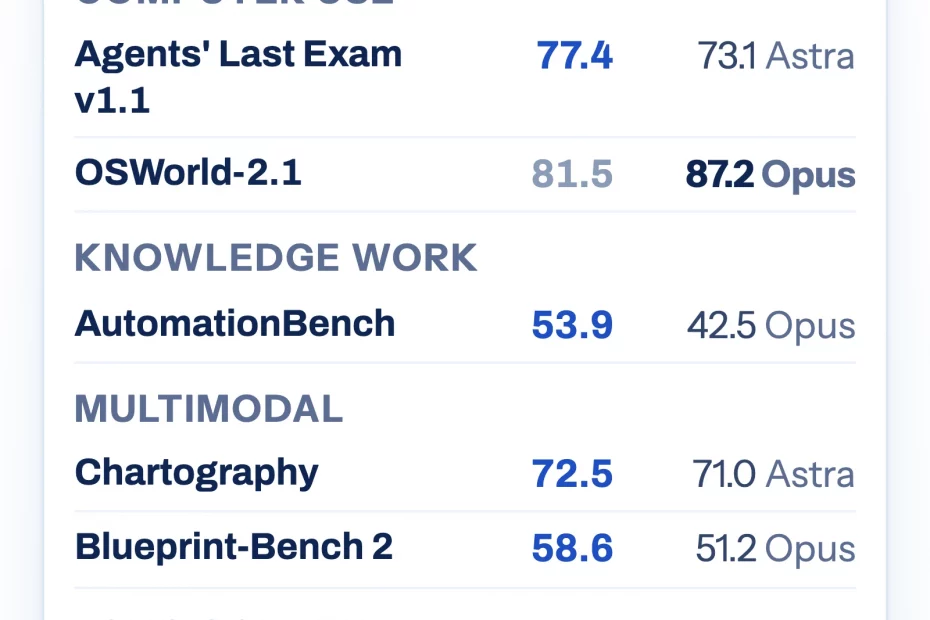
Google’s model card reports Carbon leading on 15 of 17 benchmarks it selected, against four competitors. The company says those results are as of October 2026. That comparison does not include Claude Fable 5.2, which was released November 9, and some of Carbon’s leads are narrow. The card reports losses to GPT-6 Astra on FrontierSWE 2 and to Claude Opus 5.5 on OSWorld-2.1.
The new MKA evaluation is separate from Google’s chosen model-card comparisons. Its authorship is relevant to interpreting the score: Google DeepMind co-developed the benchmark, and the task set is private. Artificial Analysis also participated in the release. The results are published, but outsiders cannot inspect the underlying tasks to independently reproduce the evaluation.
““more thinking tokens than Gemini 4 Argon to explore hypotheses thoroughly, reason deeply, and run extended verification loops.””
— Google DeepMind, in the Gemini 4 Carbon model card
Limits of the Published Comparisons
The MKA task set is private, so independent reviewers cannot check its contents or reproduce the scores directly. The results also come from a benchmark co-developed by Google DeepMind, whose model ranked near the top. The reported margin of error places the leading three models close together, and the published figures do not establish which model will perform best across real customer workloads.
Google lists known Carbon limitations including hallucinations, occasional slowness or timeouts, and higher token use, especially at higher reasoning settings. The source material does not give detailed timing or failure-rate figures for ordinary use. It also remains unclear how the MKA cost comparison was calculated beyond the reported per-task totals, or how those costs would vary with different task sizes and settings.
Artificial Analysis’s Intelligence Index is another snapshot, based on nine tests combined into a score. Its figures differ by reasoning setting: Fable 5.2 scores 65 at maximum and 62 at high, while Carbon’s high setting scores 60. These rankings should be read with their stated versions and settings; they are not a direct measure of every practical use.
Access and Pricing Through December
Paying developers and businesses can evaluate Carbon through Google’s developer and business offerings, while Google AI Ultra subscribers can access it in the Gemini app and AI Mode in Search. The next stated pricing milestone is December 1, 2026, when Google’s API rates are scheduled to move from $2 to $4 per million input tokens and from $10 to $20 per million output tokens.
Further comparisons will depend on additional independent evaluations and evidence from use beyond benchmark tasks. For now, the published MKA results establish Carbon’s second-place score in that test, but leave open how broadly its performance and reported cost advantage apply.
Key Questions
Who can use Gemini 4 Carbon now?
Paying developers and businesses can access it through the Gemini API, Google AI Studio and Gemini for business. In the Gemini app and AI Mode in Search, it is available to Google AI Ultra subscribers.
How did Carbon score on MKA?
Carbon scored 54.3%, second to Claude Fable 5.2 at 56.6%. Claude Opus 5.5 scored 53.0%; the report says the top three are within the margin of error.
What does the reported cost comparison show?
Google DeepMind reported a cost of $5.63 per MKA task for Carbon and $35.28 for Fable 5.2. The figures apply to the benchmark and do not establish costs for every customer task.
When does Carbon’s API pricing change?
Google lists introductory rates of $2 per million input tokens and $10 per million output tokens through November 30, 2026. From December 1, the listed rates are $4 and $20 per million tokens, respectively.
Can the MKA results be independently checked?
The results have been published, but the 200-task MKA set is private. That prevents outside reviewers from inspecting the tasks and directly reproducing the benchmark.
Source: Thorsten Meyer AI