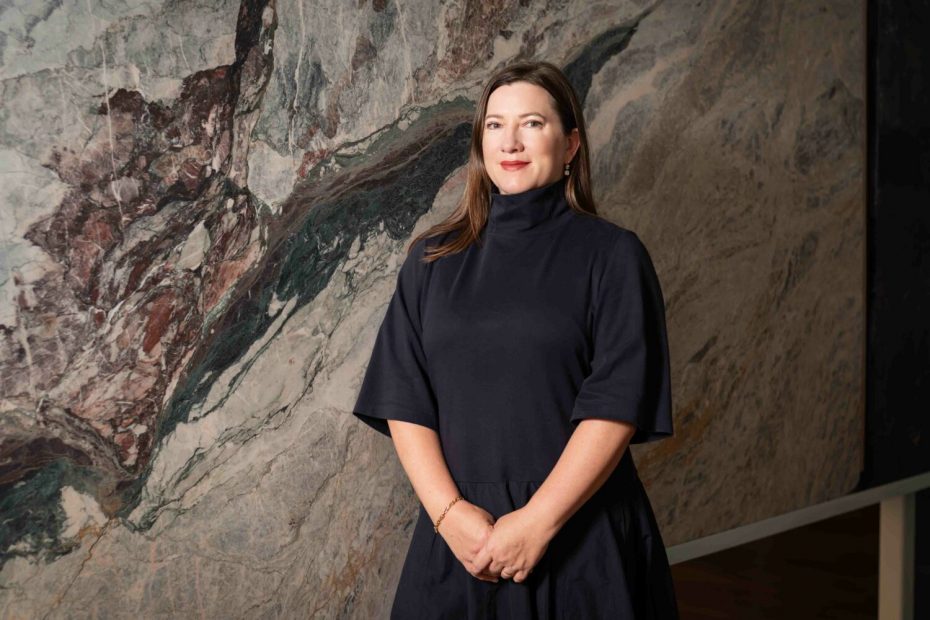
A background in fashion led April Graves to an unlikely material: natural stone. With a bachelor’s degree in Textiles and Interiors from Seattle Pacific University, a master’s degree from Central Saint Martins, and work experience at Burberry and Duchamp London, she developed a fascination with the material through Aria Stone Gallery, where she is now partner and COO.
On her first visit to the Dallas gallery for an event, she was immediately drawn to the monumental slabs in the space—so much so that she later used them as the backdrop for a fashion photo shoot.
“I discovered that natural stone could be appreciated as an art form rather than simply a building material,” she says.
Photography courtesy of Aria Stone Gallery
Graves went on to collaborate with Aria Stone Gallery several times before joining the company in 2014 to help shape the gallery’s identity. Since becoming a partner in 2020, she has helped establish a sourcing philosophy the company calls “buying wild.”
Design Milk caught up with Graves to discuss her eye for stone, where she thinks natural stone design is going, and one material she’s particularly excited about.
DESIGN MILK: How has your background in fashion shaped the way you work with natural stone?
APRIL GRAVES: Working with textiles, leather goods, and product
collections trained me to pay close attention to color, texture, craftsmanship, and how materials contribute to a brand’s identity. I approach natural stone in much the same way—not simply as a surface, but as a design element with its own character, movement, and story.
DM: When you’re walking through quarries and processors, what catches your eye first?
AG: I’m always looking for the slab that immediately stops me in my tracks. No two pieces of natural stone are ever exactly alike, which makes sourcing feel like a constant search for the needle in the haystack. I trust my first impression and look for materials with exceptional movement, character, and originality—stones that have the potential to inspire designers before they ever become the next trend.
Calacatta Vagli Oro Honed from Italy. Photography courtesy of Aria Stone Gallery.
DM: How do you encourage designers to embrace something unexpected?
AG: We encourage designers to experience the stone in person. Seeing the movement, composition, and overall visual balance of a slab firsthand often reveals possibilities that can’t be appreciated through a small sample. At Aria, we seek out exceptional [and select] stones because they challenge expectations rather than follow them. That philosophy naturally
encourages designers to think more creatively.
DM: What’s exciting you most in natural stone right now?
AG: One of the most exciting shifts I’m seeing is the intentional use of offcuts and remnant material. Traditionally, natural stone has been reserved for large applications like countertops, walls, or flooring, but designers are now incorporating those same materials into smaller custom details. It’s a beautiful way to create continuity, allowing the same stone to become a thread that ties the entire space together while celebrating every
part of the slab.
DM: Aria Stone Gallery now offers Rosso Melograno, a burgundy marble from northwestern Italy. What made you want to introduce this material?
AG: Rosso Melograno represents exactly the kind of material we’re always searching for—something distinctive that feels both unexpected and enduring. While its rarity certainly makes it special, what excited me most was its ability to answer where design is heading today. We’re seeing a greater appreciation for warmer palettes and materials with depth and personality.
A slab of Rosso Melograno from Italy. Photography courtesy of Aria Stone Gallery
DM: How do you envision designers interpreting Rosso Melograno in contemporary interiors?
AG: I actually view Rosso Melograno as a warm neutral. Although the
stone carries red undertones, it reads much more as a deep, earthy brown
than a bold red. That subtlety makes it incredibly versatile in contemporary
interiors. I see designers using it as an anchoring material that brings warmth, depth, and richness to a space without overwhelming it.
DM: What do you think is the next chapter for luxury natural stone?
AG: I think luxury is becoming less about excess and more about authenticity. Designers and clients are placing greater value on craftsmanship, provenance, and materials with genuine character. I also see natural stone continuing to expand beyond traditional applications and becoming a more intentional part of the overall design narrative. The conversation is shifting from simply selecting a beautiful material to thoughtfully curating one that brings originality, longevity, and meaning to a space.
Cappadocia Quartzite from Brazil. Photography courtesy of Aria Stone Gallery.
DM: If you could convince every designer to rethink one assumption about natural stone, what would it be?
AG: I’d encourage designers to stop thinking of natural stone as simply a surface material. Every slab is one of a kind, with its own history, movement, and character. When it’s approached as a design feature rather than just another specification, it becomes an opportunity to tell a story and create spaces that feel much more personal and memorable.
At Aria, we’ve always believed natural stone deserves to be viewed as an art
form—something that anchors a space and inspires the design around it,
rather than serving as a finishing touch.