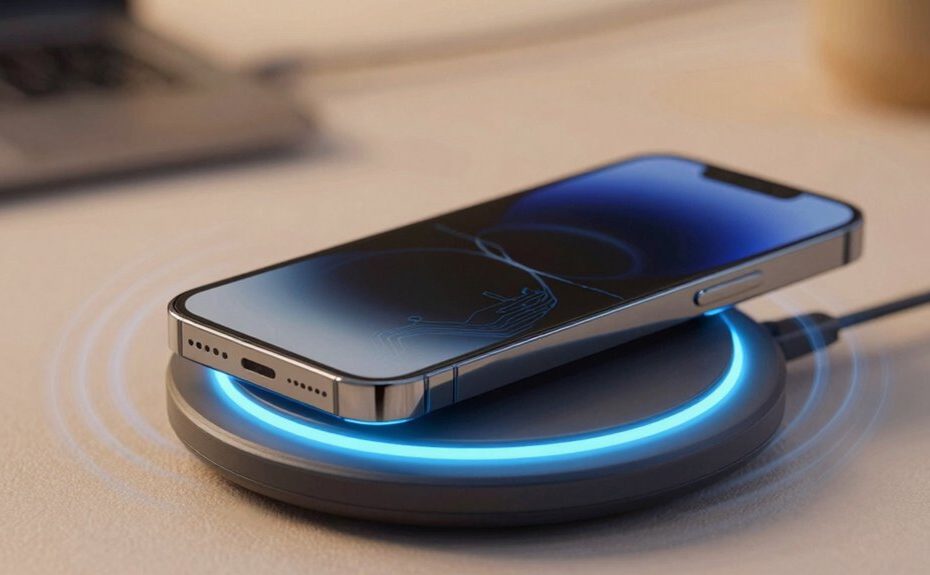
Wireless charging works by using electromagnetic induction to transfer energy from the charger to your device. When you place your device on the charging pad, a small coil inside the charger creates an alternating magnetic field. Your device has a coil that captures this magnetic energy and converts it into electrical power to charge the battery. This technology eliminates cables and reduces wear, making charging more convenient. If you’re curious, there’s more to discover about how these components work together.
Key Takeaways
Uses electromagnetic induction, where an alternating magnetic field transfers energy from the charger to the device.
The charger’s coil creates a magnetic field that induces a current in the device’s internal coil.
Proper coil alignment and standardized frequencies ensure efficient power transfer and compatibility.
Modern wireless chargers incorporate safety features to prevent overheating and improve reliability.
Devices are simply placed on the charger pad, eliminating cables and reducing port wear.
Have you ever wondered how your phone charges without plugging in a cable? It’s pretty fascinating how wireless energy transfer makes this possible. Instead of connecting a cord, your device uses a process called electromagnetic induction to draw power from a charging station. When you place your phone on a wireless charger, a small coil inside the charger creates an alternating magnetic field. This magnetic field is the key to wireless energy transfer, allowing power to move without physical wires.
Wireless charging uses electromagnetic induction, creating magnetic fields to transfer power without physical cables.
The magic happens because of electromagnetic induction, a principle discovered by Michael Faraday. When the alternating magnetic field from the charger’s coil intersects with a coil inside your phone, it induces an electric current. Your phone’s internal coil acts like a tiny generator, converting the magnetic energy into usable electrical energy that charges your battery. Basically, the charger and your phone work together as a pair of coupled coils, exchanging energy efficiently through this electromagnetic induction process.
This system relies on the precise alignment of coils, but modern wireless chargers are designed to be somewhat forgiving. As long as your phone is within a certain range and properly positioned on the pad, the magnetic fields will interact effectively, transferring power seamlessly. The entire process is quite rapid, with many chargers capable of delivering enough energy to fully power your device in just a couple of hours. Plus, because it eliminates the need for physical connectors, it reduces wear and tear on your device’s charging port.
The underlying technology of wireless charging has advanced considerably, making it safer and more efficient. Various standards, like Qi, ensure compatibility across different devices and chargers. These standards specify the frequency of the magnetic field and the way power is transferred, helping prevent overheating and ensuring reliable charging. Researchers are continually working to improve wireless power transfer efficiency and safety, leading to more sophisticated systems. This ongoing development is also driven by the need for standardized protocols that facilitate interoperability and safety features. As a result, you can often pick up a wireless charger and be confident it will work with your smartphone, smartwatch, or earbuds. Additionally, the use of high-frequency magnetic fields enhances the efficiency of power transfer, making the process even more effective.
In practice, wireless energy transfer through electromagnetic induction transforms the way you power your devices. No more fumbling with cords or worrying about port damage. Instead, you simply place your device on a compatible charging pad, and the energy flows effortlessly through magnetic fields, making charging more convenient and reducing clutter. This technology continues to evolve, promising even faster and more efficient wireless power solutions in the future, so you can enjoy an easier, more seamless way to keep your devices powered up.
Frequently Asked Questions
Can Wireless Charging Damage My Device’s Battery Over Time?
Wireless charging can cause some battery degradation over time, but it’s usually minimal if you use quality chargers. The main concern is that inconsistent power transfer efficiency might generate heat, which can accelerate battery wear. To protect your device’s battery, avoid overnight charging and high temperatures. Using certified chargers helps make certain of safe, efficient power transfer, minimizing long-term damage and keeping your device’s battery healthy longer.
How Close Does My Device Need to Be to the Charger?
Think of wireless charging like a dance—your device needs to stay in perfect step with the charger. Usually, you should keep your device within about 1-2 inches of the charging pad for maximum power transfer. Distance accuracy is vital, and even minor signal interference from metal objects or other electronics can cause issues. So, keep your device close and clear of obstacles to guarantee a seamless, uninterrupted charge.
Are There Safety Risks Associated With Wireless Charging?
Wireless charging is generally safe, but you should be aware of potential safety risks. Electromagnetic interference might affect nearby electronic devices, and some people worry about health concerns from prolonged exposure to electromagnetic fields. However, most wireless chargers meet safety standards, making them safe for everyday use. To minimize risks, avoid placing sensitive devices or medical equipment near the charger while it’s operating.
Why Is My Device Not Charging Wirelessly?
Your device might not be charging wirelessly due to wireless interference or charging compatibility issues. Make certain your device is properly aligned with the charging pad, as misalignment can prevent charging. Also, check for wireless interference from other electronic devices nearby, which can disrupt the signal. Confirm that your device is compatible with the wireless charger, as incompatible devices won’t charge wirelessly. Keep these factors in mind to guarantee smooth charging.
Does Wireless Charging Work Through Phone Cases?
Think of your phone case as a cloak that might block the magic of wireless charging. Usually, most cases are compatible, but thick or metal ones can act like barriers, thwarting power transfer. To keep the energy flowing smoothly, use cases designed for wireless charging or keep the case thin and non-metallic. If compatibility issues persist, try removing the case and see if your device starts to charge effortlessly again.
Conclusion
In your pursuit of power, understanding wireless charging’s wondrous workings reveals a remarkable blend of science and sophistication. By bridging boundaries between bulky cords and sleek smartphones, wireless technology transforms your daily device dealings. So, step confidently into the future, where convenience and cutting-edge science collide, creating a seamless synergy. Embrace this evolution, and let wireless wonders work wonderfully for your world, making mobility more manageable, modern, and marvelously effortless every moment.