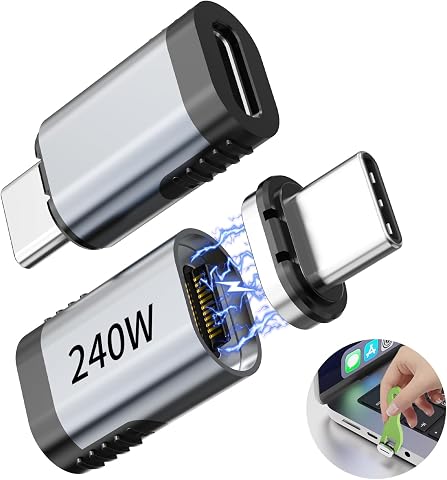
The 3C’S USB-C Magnetic Adapter 240W is a two-pack of straight USB-C connectors aimed at people who want a detachable connection for charging, data, and video. Its headline appeal is unusually broad capability on paper: up to 240W charging, 40Gbps data, and 8K at 60Hz. That makes it more versatile than a basic charging-only magnetic tip, but those figures depend on the connected charger, cable, and devices supporting the same standards. The main drawbacks are that the magnetic joint needs correct alignment and no power adapter is included. It is worth considering for a compatible laptop or desk setup where quick disconnects matter; for ordinary phone charging or a need for a rotating connector, a simpler or more adjustable alternative may be a better fit.
3C’S USB-C Magnetic Adapter 240W
Power: 240 Watts Data Transfer Speed: 40Gbps Video Output: 8K@60Hz
Why This Product Stands Out
Many magnetic USB-C adapters are bought for one simple convenience: leaving a small tip in the device so the cable can be detached quickly. The 3C’S model aims higher by listing charging, data, and video support together. If those capabilities work as described in a particular setup, the adapter can serve more than a charging-only role and reduce the need to swap between different connector types.
Its specifications place it toward the more capable end of this small accessory category. 40Gbps data and 8K@60Hz output are most relevant to people connecting fast storage or high-resolution displays; they are surplus capacity for a phone charger and many basic laptop setups. The practical distinction is whether a buyer needs a magnetic break in a full-featured connection. If the goal is only easier cable attachment, these headline limits may not add much value.
The tradeoff is the nature of the magnetic joint. A conventional USB-C plug locks into the port, while this adapter introduces another connection point that needs to meet squarely. That convenience can suit a stationary desk, but alignment and cable movement matter more than they would with a standard cable. Compared with rotating alternatives, the straight body is also less adaptable to ports with limited clearance.
Key Features and What They Mean
Up to 240W charging gives buyers with a compatible high-power laptop the option to use a charger rated for demanding devices without making the adapter the limiting part of the setup. For someone who docks a power-hungry laptop at a desk, that headroom can help preserve the charging capability their laptop and charger already support. Lower-power devices simply draw what they support, so the rating offers little practical benefit to most phone chargers. The charger, cable, and device must all support the required power, and the adapter does not include a power brick.
40Gbps data transfer can help fast external drives and bandwidth-heavy docks move large files more quickly and keep demanding peripherals connected without the adapter becoming the bottleneck. This matters most to people editing large media files, backing up data, or working with high-speed storage; routine phone transfers, keyboards, and mice are unlikely to benefit. The host port, cable, and peripheral must also support the rate for buyers to see that outcome.
8K@60Hz video output can let a compatible computer connect to a high-resolution display through the adapter without immediately limiting the video path. That gives buyers already using or planning an 8K display more flexibility in where they place a magnetic disconnect. For common office monitors and televisions, the stated ceiling is mostly unused headroom rather than a visible improvement. The source device, cable, and display must all support the mode, since the adapter cannot create video output a computer lacks.
The magnetic attachment lets the cable separate at the adapter, so a laptop can be disconnected quickly without repeatedly removing a standard plug from its port. That saves a small but frequent step for people who take a laptop away from a desk or switch between cables, and may reduce routine handling of the device’s USB-C port. The joint must align correctly and can be less secure under movement, making it a weaker match for a cable that is pulled or snagged often.
The pack contains two straight adapters, so buyers can equip two compatible devices or keep a spare ready. This is useful for a multi-device desk where more than one laptop or tablet needs quick cable detachment. The straight shape does not turn the cable away from a laptop edge or let it swivel, so buyers seeking clearance or reduced cable leverage should look for a right-angle or rotating model instead.
Performance and Real-World Use
For day-to-day use, the adapter’s appeal is mainly convenience: once the connector is in place, a compatible magnetic cable end can be detached without repeatedly handling the device’s USB-C port. In a stationary setup, that may make moving a laptop or disconnecting a peripheral simpler. The benefit depends on the magnetic connection being seated correctly; a misaligned join can weaken the hold, so this is not the best choice for a cable that is constantly tugged or for situations where an accidental disconnect would interrupt work.
Performance depends on more than the adapter’s printed limits. To reach the stated charging, data, or video capability, the source device, cable, charger or peripheral, and display must all support the needed standard. Check the complete connection path before treating the maximum figures as a reason to buy. If the device does not support 8K output or the cable tops out below 40Gbps, the adapter cannot make up the difference.
The straight design keeps the shape simple and may suit ports with clear space around them. It offers less flexibility where a cable exits toward a hand, desk edge, or laptop hinge. Durability is described as a strength, but the supplied facts do not establish a service life or resistance to repeated pulls. The package also lacks a power plug, so the adapter is one part of a setup rather than a complete charging solution.
Who Should Buy This
This is a sensible option for MacBook or other compatible USB-C laptop owners who regularly connect and disconnect a cable at a desk and want one adapter that can carry charging, data, and video when their existing equipment supports those functions. It also suits buyers with a compatible Thunderbolt setup or demanding peripherals who have checked that their host, cable, and accessories can use the listed bandwidth. The two-pack is useful if two devices need the same convenience. The strongest case is a mostly stationary setup where fast detachment is useful and the connector is unlikely to be pulled sideways.
Who Should Skip This
Skip it if you need a charger included, since the package has no power plug, or if you expect the adapter itself to deliver maximum charging or video performance regardless of the rest of your gear. Buyers who use their devices while walking around, frequently move cables, or need a connection that stays firmly locked under tension may prefer a conventional USB-C cable. If port clearance is the main problem, a right-angle or rotating adapter is a closer match; the 3C’S straight design does not change the cable direction.
Value for Money
At a mid-range price, this is worth buying for buyers who will use both the magnetic disconnect and the full-featured connection—especially compatible laptop owners with fast storage, docks, or high-resolution displays, and a second device that can use the other adapter. The two-pack and broad stated capability give it a reasonable case when they replace a charging-only magnetic tip or simplify a demanding desk setup. For basic phone charging or a single low-bandwidth connection, it is not worth paying a premium for 240W, 40Gbps, and 8K headroom that the setup will not use. It is also poor value if you mainly need an angled or rotating cable position, or still need to buy a suitable charger and cable. Buy it when the compatible features solve a specific setup problem; otherwise, a simpler adapter is the better value.
3C’S USB-C Magnetic Adapter 240W
Many magnetic USB-C adapters are bought for one simple convenience: leaving a small tip in the device so the cable can be detached quickly. The 3C’S model aims higher by listing charging, data, and video support together.
Pros:
Supports charging up to 240W, giving compatible high-power laptops room to charge without choosing a lower-rated connector.The stated 40Gbps data rate suits fast external storage and other bandwidth-heavy peripherals when the full connection supports that speed.8K@60Hz video support gives compatible display setups headroom beyond everyday monitor needs.The magnetic connector makes detaching a connected cable quicker than unplugging a conventional USB-C cable each time.Two adapters in the pack can serve more than one device or provide a spare, which is useful for a multi-device desk.
Cons:
The 240W, 40Gbps, and 8K claims are maximum capabilities, not guaranteed results with every cable, charger, computer, or display.A magnetic connection can be less secure when the pieces are misaligned, which may make it a poor fit where cables are frequently pulled or moved.The straight design offers no angled or rotating positioning, so it may not relieve cable strain in cramped or side-facing ports.No power plug is included, so buyers still need a suitable charger and cable to make use of its charging capability.
Best for: Owners of compatible USB-C or Thunderbolt devices who want a compact magnetic disconnect for charging, data, and video.
Not ideal for: Buyers who need a power brick, a highly secure connection under movement, or a rotating/right-angle adapter.
Bottom line: The 3C’S USB-C Magnetic Adapter 240W is worth buying when you want quick magnetic disconnects and have compatible equipment that can use its charging, data, or video capabilities.
Frequently Asked Questions
Will this adapter charge every USB-C laptop at 240W?
No. 240W is the stated maximum. Actual charging depends on the laptop, charger, and cable, and the device draws only what it supports. The adapter does not include a power plug.
Does 8K@60Hz work with any USB-C computer or display?
No. The computer or other source must support the required video output, and the cable and display must also support the connection. The adapter’s specification cannot add 8K output to an incompatible device.
Is a magnetic adapter secure enough for a laptop used on the move?
It may suit a mostly stationary setup, but the magnetic pieces need to align correctly and can be less secure if they do not. If the cable is likely to be pulled or moved often, a conventional cable may provide a more dependable connection.
Should I choose this or a rotating USB-C magnetic adapter?
Choose this model if a straight connector fits your port and you value the listed charging, data, and video capabilities. A rotating or right-angle alternative is a better fit when cable direction, clearance, or reducing strain near the port matters most.
Final Thoughts
The 3C’S USB-C Magnetic Adapter 240W is worth buying when you want quick magnetic disconnects and have compatible equipment that can use its charging, data, or video capabilities. Its two-pack and unusually broad stated support make it a versatile choice for a stable desk setup. The main conditions are a properly aligned connection and a suitable cable and charger, which you must supply separately. If you only need ordinary charging, move cables around often, or need an angled connector, choose a simpler, conventional, or rotating alternative. Buy it for a specific compatible setup, rather than for the headline numbers alone.