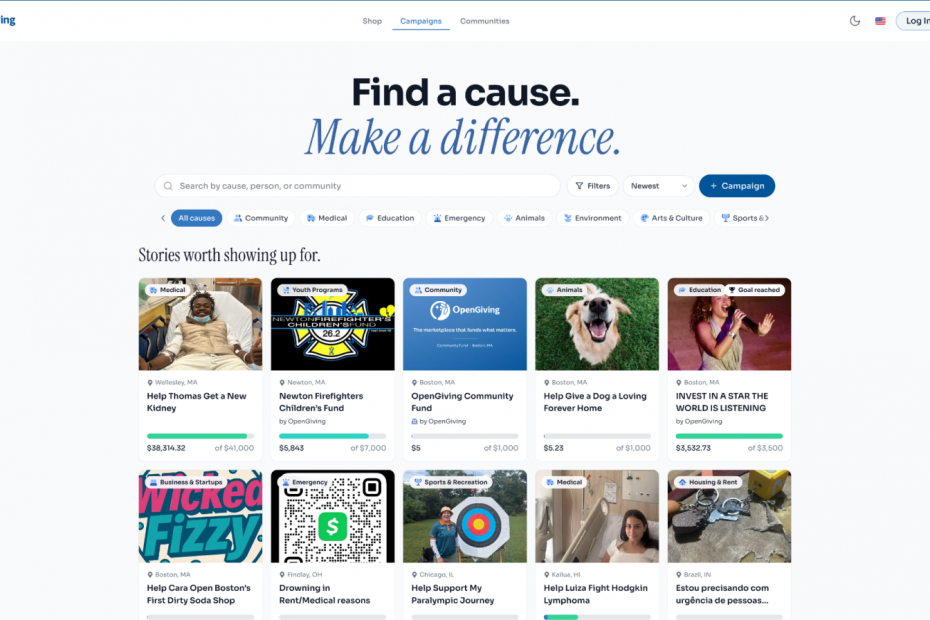
Sellers list goods, digital products, and services, choose a campaign, and decide how much of each sale it receives.
United States, November 25, 2026 — OpenGiving, a peer-to-peer fundraising marketplace, lets people buy and sell products and services while sending part of each sale to a fundraising campaign. A seller lists an item, chooses a campaign, and sets the percentage it receives. When the item sells, the campaign gets its share, and the seller keeps the rest.
OpenGiving is completing its beta ahead of a full launch and is available at opengiving.us and as apps for iOS and Android. Most campaigns on the platform raise money for medical treatment, education, and community causes. Listings range from clothing, electronics, and collectibles to study resources and creative services.
OpenGiving was founded by James Fang, its CEO, and Enricco Gemha, its CTO. Jerry Gao, its COO, oversees the development of the marketplace.
Starting a campaign costs nothing: an organizer explains the need and sets a goal. Supporters can then donate directly or help through the marketplace, either by selling physical items, digital products or services, or by buying something linked to the campaign. Sellers can direct 5% to 100% of the price of a physical item or service to their chosen campaign, and 0% to 100% of the price of a digital product.
A supporter who sells a jacket for $100 and pledges 30% to a friend’s medical fundraiser sends $30 to the campaign and keeps $70. A graphic designer can put $50 from a $200 logo project toward a student’s education fundraiser. In each case, the contribution appears on the seller’s GivingProfile, a shareable record of the campaigns they’ve supported and how much they’ve helped raise over time.
“Everyone can take part in a way that fits what they have to offer,” said Gao, describing the students, creators, individuals, and small businesses OpenGiving is focusing on first. “A student might sell a textbook, a designer might offer a service, or a business might connect its products to a campaign.”
Creating a campaign and making a direct donation are free. Sales of physical goods and services carry a 5% platform fee and a separate 4% payment processing charge, which the buyer pays on top of the listed price, so the seller decides how the full price is divided. Digital purchases carry a flat $1 fee, of which $0.70 goes directly to the campaign.
Buyers’ payments are held until delivery is confirmed and only then released to the seller. OpenGiving reviews every campaign organizer before funds are paid out, and any signed-in user can report a campaign for review if something looks wrong. OpenGiving does not handle credit card details; all payments run through accredited third-party processors. Each campaign page shows how much it has raised and who supported it, unless supporters choose to give anonymously.
Over the next year, OpenGiving plans to partner with communities that have pressing fundraising needs, work with university clubs on community activities and ambassador programs, and bring sellers from other marketplaces onto the platform.
“We believe the ways people contribute to others deserve a visible place alongside their personal and professional achievements,” said Fang.
About OpenGiving
OpenGiving is a peer-to-peer fundraising marketplace where people buy and sell goods, digital products, and services, with sellers directing a chosen share of each sale to a campaign. Campaign organizers can raise money through direct donations and marketplace sales, and every contribution is recorded on a shareable GivingProfile. OpenGiving was founded by James Fang and Enricco Gemha. More information is available at opengiving.us.
Contact Info:
Name: Jerry Gao
Email: Send Email
Organization: OpenGiving
Website: https://opengiving.us/home
Release ID: 89210836
If you detect any issues, problems, or errors in this press release content, kindly contact error@releasecontact.com to notify us (it is important to note that this email is the authorized channel for such matters, sending multiple emails to multiple addresses does not necessarily help expedite your request). We will respond and rectify the situation in the next 8 hours.
Source: MarketersMedia