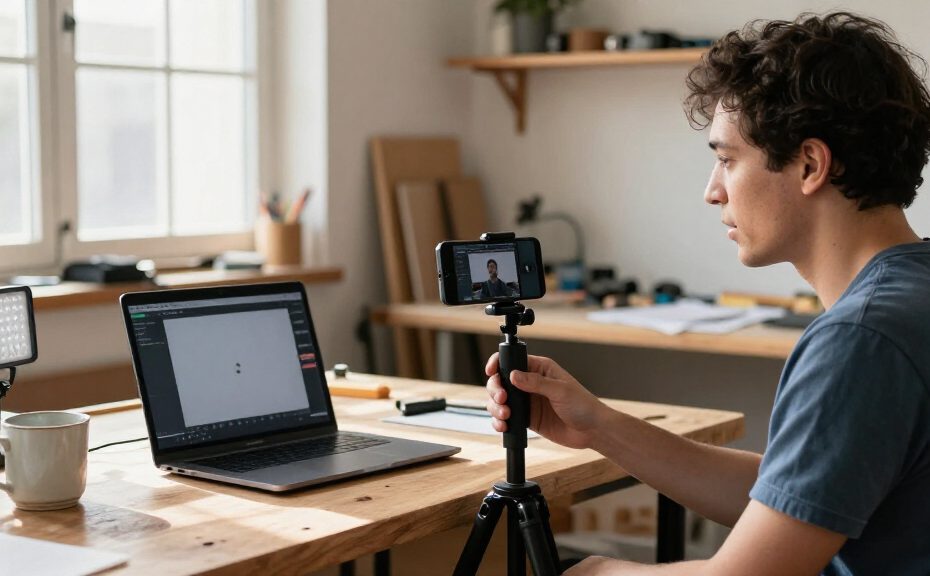
Full opportunity report: Practice App Helps Business Owners Prepare To Speak On Camera on IdeaNavigator AI — validation score, market gap, and execution plan.
TL;DR
IdeaNavigator AI has proposed a practice app for business owners who struggle to record videos, with short exercises and automated feedback on delivery. The concept is still at the proposal stage; a 30-day test with 100 owners and a waitlist comparison is suggested, but no results or launch details are available.
Recommended by digitechbytes.com · AI-assisted guides
Shopping for agency operations? Start with the guides we keep up to date:
Updated October 202615 Best Portable Thermal Cameras for Home, Work, and Field Use in 2027See the top picks →Updated October 202615 Best Smart Halloween Doorbell Cameras for 2027See the top picks →Updated October 202615 Best Smart Home Halloween Security Cameras for 2027See the top picks →
IdeaNavigator AI has proposed a practice app for business owners who know video could help their marketing but struggle to speak naturally while recording. The concept pairs two-minute daily exercises with automated feedback, though it remains a product proposal: no app launch, completed trial or user results are reported.
The proposed app is aimed at owners who freeze, stumble, criticize their own delivery or repeat takes when trying to record alone. The pitch argues that conventional public-speaking training may not address this particular setting: speaking to a camera without an audience, then deciding whether the recording is good enough to publish. That distinction is central to the product idea, rather than evidence that existing courses have been tested and found ineffective.
The suggested minimum product would offer daily, two-minute prompts that progress from reading prepared material to speaking more freely. It would analyze delivery measures such as pace, filler words, eye line and energy, then show users how those measures change over time. The proposal also describes confidence streaks and a step toward recording real business content. These are planned features, not confirmed capabilities of an available product.
For validation, IdeaNavigator AI proposes a 30-day cohort of 100 business owners, comparing how many publish a first real video by day 45 with participants on a waitlist. The material does not report that this study has started or provide findings. It also suggests a consumer subscription and a team plan for agencies that coach clients, without pricing or evidence of demand.
Concept brief / creator confidence
Practice for the camera. Publish with confidence.
IdeaNavigator AI has proposed a practice app for business owners who struggle to record video. Short daily exercises and automated delivery feedback are part of the concept; the app and its results remain unverified.
The central question
Can private rehearsal help owners move from repeated takes to publishing a real business video?
The proposal suggests a pilot to find out. No study start date, launch, or findings have been reported.
Proposal stage
From camera nerves to a first take
The intended user already sees video as useful for marketing but may freeze, stumble, repeat takes, or criticize their delivery when recording alone.
Practice
Start with a small prompt
Daily two-minute exercises would progress from reading prepared material to speaking more freely.
Feedback
Notice delivery patterns
Possible feedback areas include pace, filler words, eye line, and energy, with changes tracked over time.
Progress
Build toward real content
Confidence streaks and a step toward recording business content are planned ideas, not confirmed app features.
A pilot would test behavior, not just practice
The proposed success measure is whether participants publish a first real business video by day 45, compared with a waitlist group.
Recruit owners
Proposed cohort of 100 business owners.
02
Practice for 30 days
Use short, progressively less scripted exercises.
03
Compare groups
Set the cohort against a waitlist comparison.
04
Check day 45
Measure how many publish their first real video.
Signals need context
Automated delivery measures could support practice, but the proposal gives no technical method, accuracy assessment, or independent evaluation.
Proposal versus evidence
The material outlines a product direction and possible business model. It does not establish product availability, demand, or effectiveness.
TopicOutlined in proposalStill unknown
ProductConcept Short prompts, delivery feedback, confidence streaks.No working app, launch, development status, operator, or timeline reported.
TrialSuggested 30-day cohort of 100 owners; publication check by day 45.No start date, protocol, recruitment details, or results.
Data & qualityPossible measures Pace, filler words, eye line, and energy.Data collection, storage and deletion, opt-outs, accuracy, and evaluation.
Business modelOutline Individual subscription and possible agency team plan.Pricing, willingness to pay, agency interest, and customer commitments.
What would a useful result need to answer?
A publication rate could offer an early signal. More evidence would be needed to understand lasting use and whether the idea can work across business contexts.
Is the app available now?
No launch is reported. IdeaNavigator AI describes a product concept and proposed features.
Who is it intended for?
Business owners who want to use video but feel uncomfortable recording themselves, especially those who repeat takes or become self-critical.
Would practice lead to sustained posting?
Unknown. The proposed day-45 measure would look at first publication; repeat use and ongoing posting also remain open questions.
What else needs validation?
Feedback reliability, data handling, user willingness to pay, and whether results hold across industries and business sizes.
Practice → publication → evidence
The concept’s value depends on a measurable move from rehearsal to real business communication.
Delivery guidance→
First published video→
Compare by day 45
Source: IdeaNavigator AI · Concept and pilot details remain unconfirmed
Powered by Thorsten Meyer AI
A Test of Video Coaching Demand
The idea addresses a practical barrier for small businesses: owners may see video as useful but fail to publish because recording feels uncomfortable. A tool that makes rehearsal private and brief could offer a lower-commitment route to practice than a course or a live coaching session. Whether it changes publishing behavior, rather than simply generating practice sessions, is the central question.
The proposed pilot focuses on that outcome by tracking whether participants publish by day 45. A comparison with a waitlist could offer an early signal about whether the exercises help, although the proposal provides no study protocol, recruitment details or results. Even a positive result in a small cohort would not by itself establish how the app performs across industries or business sizes.
There is also a distinction between measuring delivery and measuring communication quality. Pace, filler words and eye line can be counted or estimated, but their significance depends on the speaker, audience and purpose of a video. The product would need to present such feedback as guidance rather than a definitive judgment of whether a person is persuasive or competent.
From Marketing Pressure to Rehearsal
The proposal frames the timing around video becoming a marketing expectation for businesses of different sizes. Its intended user is not someone seeking general presentation training, but an owner who already accepts that video may matter and finds the act of recording a barrier. The problem statement includes repeated takes and self-criticism as reasons people may avoid the channel.
The concept also relies on multimodal AI to assess aspects of spoken and visual delivery. IdeaNavigator AI identifies pace, filler words, eye contact or eye line, and energy as possible feedback areas. No technical approach, accuracy assessment, privacy policy or independent evaluation is provided, so those features should be understood as proposed capabilities rather than verified performance.
The business model remains an outline: individual subscriptions, with a possible team tier for agencies supporting clients. The market is described as communication-skills training. No price, named product, company launch, customer commitments or competing-product analysis is included in the proposal.
Product and Trial Details Pending
No working app or completed pilot is described. It is not clear whether development has begun, who would build or operate the product, when a cohort might be recruited, or how participants would be selected. The proposed day-45 publishing measure is an intended test, not a reported outcome.
Important product questions also remain open, including what video or audio data would be collected, how recordings would be stored or deleted, and whether users could opt out of particular analyses. The proposal does not explain how the app would estimate eye line or energy, how reliable those assessments would be, or how feedback would account for differences in speaking style and recording conditions.
There is no disclosed subscription price, evidence that business owners would pay, or information about agency interest. It is also unknown whether the exercises would lead to sustained posting after the initial practice period. Those uncertainties leave the concept’s effectiveness and commercial prospects untested.
Pilot Would Measure First Publication
The next stated step is to recruit a 30-day group of 100 owners and compare its publication rate by day 45 with a waitlist control. For that test to establish a useful early signal, organizers would need to specify recruitment, the comparison process and what counts as publishing a real business video. None of those details, nor a schedule for the study, has been announced.
If the pilot proceeds, the reported outcome could show whether users move from rehearsal to publication. Further information would still be needed on repeat use, the quality and consistency of automated feedback, data handling and willingness to pay. Until a test is conducted and results are shared, the app should be treated as a proposed product rather than a demonstrated solution.
Source: IdeaNavigator AI
Key Questions
Is the camera-practice app available now?
No launch is reported. IdeaNavigator AI describes a product concept and proposed features, not an app currently available to customers.
Who is the proposed app for?
It is aimed at business owners who want to use video but feel uncomfortable recording themselves, particularly those who struggle with repeated takes or self-criticism.
What would the app do?
The proposed version would use short daily prompts and assess delivery measures such as pace, filler words, eye line and energy. These functions have not been confirmed in a released product.
How would the idea be tested?
The proposal calls for a 30-day cohort of 100 owners and a waitlist comparison, measuring how many publish a first real video by day 45. No trial results or start date are provided.
What remains unknown about the business?
Pricing, development status, data practices, the accuracy of automated feedback and customer demand have not been disclosed. The suggested individual subscription and agency team tier are possible models, not confirmed offerings.
Source: IdeaNavigator AI