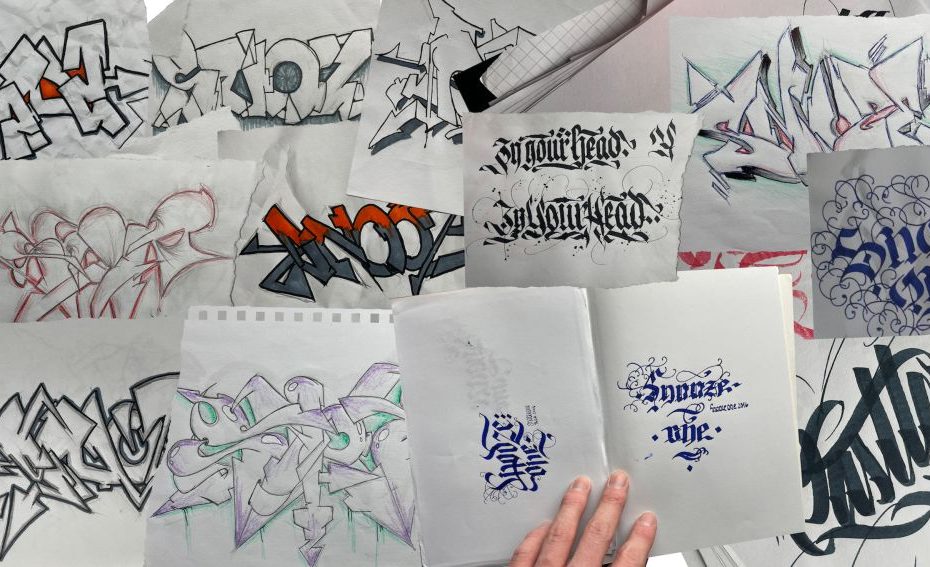
At a time when our modern culture is dominated by finished products and outputs (cough, cough—generative AI—cough, cough) the German lettering artist who goes by the nom de plume Snooze, is all about the exact opposite. For Snooze, true artistry and what he finds fulfilling about making art lies directly within the act of experimenting, testing, failing, trying again, and seeing what directions his tools and materials take him in next. He shares process videos on his Instagram that offer a peek behind the curtain at this experimentation, and help preserve and celebrate the human-made quality of his work.
After taking quick dip into the endlessly impressive and inspiring process-driven world of Snooze’s “calligraffiti” (a hybrid of calligraphy and graffiti), I reached out to the artist himself to learn more. How could I not!? Snooze’s thoughtful reflections to my questions are below.
Where does your love for lettering, letters, typography, and experimenting with type come from? How and when did that originate?
I found my love for letters through graffiti at an early age. It was probably at this time where I really started to look at letters as something more than is just there to be read.
After a couple of years, my godfather gifted me a parallel pen with a T-shirt of the artist SHOE (Niels Shoe Meulman) from Amsterdam. SHOE founded the “calligraffiti” movement, and I saw how he combined the shapes of calligraphy with the freedom and expression you find in Graffiti. That really inspired me to start getting into Calligraphy. So for the next few years I practiced calligraphy, and it showed me that there is a whole world to this letter thing.
From there, one thing led to another. I explored brush pen calligraphy, different lettering styles, sign painting, and typography. My work became a mix of all of these influences. I was always curious to find new ways to write and build letters, finding new tools and techniques.
Of all the art forms to get into, why lettering specifically? What is it about letters and type that excites you the most as an artist?
What excites me about lettering is that the possibilities to experiment are basically endless. You have the letters as a fixed framework, but anything else can be changed. You can change what you are writing on, what you are writing with, the techniques you use and the style you work in. So even though you might write the same word over and over again, there are countless ways to approach it to make it look and feel completely different.
What excites me about lettering is that the possibilities to experiment are basically endless.
And then there’s the meaning of the words themselves. Lettering gives you the possibility to express yourself quite literally and to write something you would like to read or put into the world. At the same time, the way you design those letters can emphasize, support, or even change how the words are perceived. So, the visual appearance and message become one thing.
How do you come up with the ideas for your lettering experimentation? You often use unconventional materials a lot—how do you find these, and what leads you to work with them?
Most of the time my projects grow out of something I have done before. I look at previous projects and ask myself how I could mix things up or change a variable. What happens if I keep the same technique, but change the writing tool or the surface? Or can I combine ideas or techniques that I have explored separately before?
Other times, I simply come across a tool or a material I haven’t used before and get curious about what I could do with it to create letters. I am especially drawn to things you would not normally associate with lettering. That could be a tool like a metal needle tip, or combining lettering with other techniques like stop motion or even growing plants in the of shape letters.
Using new or ordinary tools, I start to think of how I can use the same tool differently. The metal needle tip for example, I first started using to create a liquid like letters, mixed with some string gel. Then I stumbled over the fact that if you leave enough air in it, you can create bubbles and their texture can form letters.
And sometimes, the ideas really are just happy accidents. Like when I started experimenting with writing on a compressed cellulose sponge. Things like that can start quite randomly, but once I see something interesting happening, I always ask myself if I can use that to write or build letters.
I also pay attention to whether the process itself is visually interesting, because more than often the final result is a process video.
What have been some of your favorite lettering experiments, whether based on the process or the outcome?
The first projects that come to my mind are my cardboard letterings. The idea started quite spontaneously from wanting to create three-dimensional letters. While working with the material, I realized how versatile cardboard actually is. You can cut it, rib it, layer it, play with the different textures and colors. I also like the fact that I was only reusing cardboard and packaging material I already had. It became a good example of how you can use what you already have and what is already around you to create something new.
Another group of projects that come to mind are the experiments I usually do around Christmas and New Year. I try to come up with something special for those occasions and challenge myself, and they often lead to techniques I probably would not have explored otherwise. For example, I created a lettering out of cocoa powder and flour, cut cookie dough into letters, used paper strings to lay out letters and made a stop-motion animation for the New Year 2026.
Whenever I stumble across a new technique or an unexpected way of making letters, it feels like opening a whole new set of possibilities that give me several new ideas for what I can try next.
I like these projects both for the process and the outcome, but also for what I learn from them. Whenever I stumble across a new technique or an unexpected way of making letters, it feels like opening a whole new set of possibilities that give me several new ideas for what I can try next.
Why is sharing process videos of your work such an important part of your practice?
Looking back, I think I initially started making process videos mainly because of social media. Videos simply performed better, and there’s obviously an entertaining or satisfying aspect of watching something being made that works well on these platforms.
However, over the years, I learned to appreciate a deeper aspect of documenting my work. The process is why I do it in the first place. The act of writing and creating. Recording this became a way of preserving some of that experience and sharing it with others.
Over the years, I learned to appreciate a deeper aspect of documenting my work. The process is why I do it in the first place.
I think it’s similar to why I often enjoy looking at rough and unfinished sketches much more than a perfectly cleaned up final artwork. In a sketch, you can still see the decisions, the changes, the thoughts and ideas.
And, in a way, the process videos have also become a way to show the hand-made and human-made side of my work.
The art and design world (much like many industries) can be hyper-focused on finished products and results. Meanwhile, your body of work and presence as an artist very intentionally highlights process and trying new things. Can you speak to the importance of doing this at a time when the value of process is being minimized?
The more the value of the process is being minimized, the more important it becomes to highlight it again. I am a big fan of sharing not only the polished process, but also sketches, mistakes, failed attempts or directions that I eventually decided no to follow. However, even with my process videos, a polished 20-second reel doesn’t sow the whole process, just like a cleaned up final artwork doesn’t tell you much about everything that happened before it. I started to share more clips and insights of my process inside my Instagram stories and recording the whole process with commentary, to give a deeper insight into the process aside from the short-form content I post.
The more the value of the process is being minimized, the more important it becomes to highlight it again.
I remember when I started getting into lettering and was looking at other pieces on Instagram, I would see all these polished finished pieces. It can easily give you the impression that someone just had an idea and executed it perfectly. There is value in showing that it might take several attempts, or that the final idea might just come through the process, or that it sometimes doesn’t work out at all. It’s also a matter of transparency for me.
There is value in showing that it might take several attempts, or that the final idea might just come through the process, or that it sometimes doesn’t work out at all.
Beyond that, I think the process has value in itself. I once made a piece where I wrote the phrase “It’s all about the process, not the result,” word by word, and painted over each word again until, in the end, I was left with almost a blank piece of paper. This was by choice a bit provocative and a response to generative AI and the growing possibility of taking shortcuts on the process.
From a commercial perspective, I understand the appeal of getting to a result fast. But as an artist, it makes me ask why I would want to skip the part I actually enjoy in the first place? Very often I don’t even know exactly what the result will be when I start.
From a commercial perspective, I understand the appeal of getting to a result fast. But as an artist, it makes me ask why I would want to skip the part I actually enjoy in the first place?
Also, there’s a big difference between using technology as a tool within your creative process and using it simply to get to a result as quickly as possible. For example, working on the iPad can open completely new possibilities and can become part of the experimentation itself. This is not a critique against doing things differently, but in the end, efficiency isn’t the goal for me.
The post The “Calligraffiti” Artist Snooze is a Master of Type Experimentation and Process appeared first on PRINT Magazine.