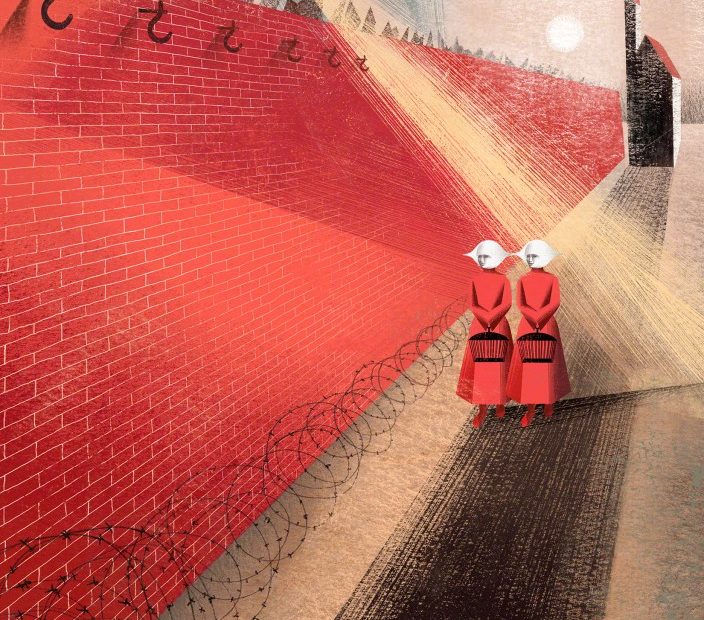
Anna and Elena, identical twins known by the nom d’crayon The Balbusso Twins, see their collaboration as a symbiotic process where they “melt into a single multi-creative identity.”
Although their extremely fluid geometric style has been frequently seen in American exhibitions and publications, they are currently having their first New York exhibition, Balbusso Twins: Illustrating With Two Souls, at the Society of Illustrators.
With extinction hanging over the illustration world, Anna and Elena are the toast of the town for reinvigorating the conceptually decorative. Their work radiates as brightly as the artists themselves, and to see it hanging in the Society’s gallery gives the grand old establishment, founded in 1901, a fresh glow and glimmer.
I asked the Balbusso Twins what it’s like to be separate souls viewed by the world as one entity.
The Handmaid’s Tale: The Wall. Interior artwork for deluxe Folio Society edition of The Handmaid’s Tale by Margaret Atwood, 2012. Awarded the Gold Medal by the Society of Illustrators
How long have you been twins?
This is a funny question! We don’t feel like clones of each other at all. Our parents raised us as separate individuals, each with our own things. We never swapped clothes (even our height and sizes are slightly different). We see and feel ourselves as different people, but we have always felt like twins. Being twins is an ancestral bond of deep love, maybe even stronger than the bond between a mother and child. It is a condition where “we” comes before “I.”
The Handmaid’s Tale: Pregnant. Frontispiece artwork for deluxe Folio Society edition of The Handmaid’s Tale by Margaret Atwood, 2012. Awarded the Gold Medal by the Society of Illustrators.
When did you decide to work as one?
Our partnership was a natural evolution. As children and students, we always drew separately, and we had separate work experiences before becoming illustrators. Our early training in graphics and photography at the “G. Sello” Art High School in our hometown of Udine was fundamental; in fact, we first imagined ourselves as graphic designers in a studio.
However, after our degree in painting at the Brera Academy and two years of theoretical study at the State University of Milan (modern literature and art history), we realized we wanted to be independent to express our creative freedom. Illustration was the perfect meeting point: It allowed us to combine our passion for drawing and painting with the pleasure of seeing the work applied to a finished product.
We decided to work as an artistic duo with a single signature at the beginning of our career to avoid competition between us. Our signature was officially born in 2000, with our first website and the creation of our logo. Since then, the logo has evolved, and the latest version is from 2023. Today, the brand “Balbusso Twins” is a symbiotic process where two individuals melt into a single multi-creative identity.
Autoimmune disease. Illustration for the personal essay “What’s Wrong with Me?” by Meghan O’Rourke, The New Yorker, 2013.
Do you talk regularly about the direction that your work is taking?
We discuss our direction constantly. We are proof that you can be successful professionals while maintaining a free and ever-evolving artistic style, focused on the effectiveness of the message. Marketing ideas suggest that an illustrator must have a single monolithic style to be recognizable; we represent the exact opposite. We believe in multidisciplinarity: We integrate tools and languages from different disciplines to solve complex communication problems in a targeted way. Our approach is akin to academic research. We conduct in-depth iconographic research that includes the study of the subject matter and theoretical exploration across literature, history and art history, to extract pertinent visual solutions. This research is not an end in itself but is functional to the project and the client’s objectives. This is why choosing the right project is essential: It must allow us to develop an accurate visual strategy in line with our vision. We have a clear vision of our path, even if we don’t know exactly what we will do; it will depend on the opportunities we encounter.
However, we know with certainty what we do not want to do. This awareness is our compass: We do not follow a rigid plan, but the consistency of our refusals guarantees the integrity of our vision. This requires the courage to know how to say no. We define our identity not through the repetition of a style, but through the quality and relevance of the challenges we choose to embrace. Our work is not limited to
replicating an aesthetic cliche. We take the risk of being unpredictable to respond precisely to every new communication challenge. This requires strong self-criticism. We want to be free to adapt our language to the communication purpose we need to achieve. Our formula is: Multidisciplinary research + Versatility = Creative Freedom.
Fetal monitoring. Opener artwork for Sophie Elmhirst’s feature article “The Battle Over Birth: Why Do So Many Expectant Mothers Feel Judged, Anxious, and Inadequate About How They Deliver Their Babies?” in The
Economist’s 1843 magazine, 2020.
Have you done anything without the other’s input?
No, we have never done anything without the other’s input. There is always a dialectic and a constant exchange between us. Even if one of us starts an idea, the other always adds her vision or a detail. Every project is a journey we take together from the beginning to the end.
Rock. Opener artwork for The Directory of Illustration 37, the world’s leading illustration resource for art directors who regularly hire freelance artists and animators. Serbin Creative, 2021.
What are your favorite subjects to work on both alone and together?
We always work together as a duo. We don’t have a preference for specific subjects, but rather for the approach. We appreciate commissions that allow us to have a critical approach. Many times, the idea of a “fresh and light” image is just a way to hide the simplification of form and content. We are complex, and for us, complexity is not a limit. We love experimentation and we love change: We always try to move
beyond overly repetitive commissions and constantly seek new experiences, even in different sectors. We love working on posters with strong themes. For now, this is part of our independent artistic research, like our 2018 screenprint series for Dark City Gallery (inspired by The Handmaid’s Tale). We would love to design theater posters and see our work applied in large dimensions. Large scales highlight our
painterly layering and show the full potential of our images. We see the image as a powerful stage for communication.
Free and creative teaching (opener). Interior artwork for a feature article in Texas Law Magazine titled “Expert Speech” by David M.Rabban that examines the First Amendment rights of academic freedom. Pentagram Austin, 2025.
What are your individual influences?
We share the same multidisciplinary background, so our influences are intertwined: painting, graphic design, architecture, photography, cinema. Our primary sources are classical art and the Renaissance. Because of this, there is a constant tension in our work towards idealization, harmony, balance and universal beauty. Our images are classical and contemporary at the same time; our figures are universal
prototypes that transcend time. For us, elegance is a fundamental value. We often use symmetry because it is part of how we see reality; our faces are often frontal, inspired by Roman portraiture, and they look directly at the viewer, but we are also able to break the balance if the story requires it. However, this search for harmony does not stop us from creating images with strong social content. We work on sensitive and urgent topics like Civil Rights, abortion, and violence against women.
Our images can be provocative or disturbing, but they always keep their elegance and beauty. We believe that beauty has an ethical value and it is necessary to engage the viewer and talk about difficult subjects. We feel a deep connection with Renaissance artists—like Pinturicchio or Filippino Lippi—who descended into the excavations of Roman villas, such as Nero’s Domus Aurea, to bring back to light the Pompeian style. When we are in difficulty and cannot find the creative spark, we sit on the sofa and open our “magic book”: Domus: Wall Painting in the Roman House.
This ritual explains our philosophy: to create beautiful images, we need to go deep. Our work is not “fast illustration”: It requires time, reflection, study and great dedication. We need to “excavate” into history and literature to find the right path. For us, quality and beauty are born from deep roots. In our work, these artistic references to Classical and Renaissance art history coexist with 20th-century avant gardes—from Futurism, Constructivism and Bauhaus to Art Deco. There is a cross-pollination with contemporary languages such as kinetic or conceptual art.
Inspiration for us is everywhere: Beyond our magic book, the incredible iconographical research in our rare 1980s collection of FMR magazine, founded by Franco Maria Ricci, often shows us the way, covering themes ranging from Byzantine mosaics to contemporary architecture.
Wars. Poster for “Conflicts, Wars and Traumas” for the 21st conference of L’Autre Revue Transculturelle, France, 2019.
Tolleranza. Poster designed for the Tolerance Project, a traveling poster exhibition curated by Mirko Ilić Corp. 2021.
What do you hope the viewer will take away from your work?
We hope the viewer finds a moment of reflection through our work. We want to demonstrate that beauty has an ethical value. For us, beauty is a way to respect the viewer and bring attention to important topics. As an artistic duo, we believe an image can be complex and beautiful at the same time. We challenge the stereotype that a social theme must have a minimal or neglected aesthetic. Visual pleasure does not distract from the content but makes it universal. We love images with strong ideas and expressive power, but always with elegance and care. We want the viewer to feel that behind every image there is a deep, authentic soul and a serious commitment. Our audience is broad; you don’t need to be an expert to understand our art. Our images must speak to everyone, and each person will find something
different based on their own feelings. Empathy and emotions are always present in our work. The most beautiful thing we were ever told was by the staff at the BCBF (Bologna Children’s Book Fair): They said that while they were setting up our exhibition, they felt deeply moved. This is exactly what we hope for: to touch the hearts of people. Achieving this is not easy; it is part of our daily challenges.
The post The Daily Heller: Four Eyes With One Vision appeared first on PRINT Magazine.