“Enter The Machine is a body of work dedicated to expanding the scope of portraiture to include digital entities, such as files, folders, programs and information systems,” writes Eric Corriel, a conceptual artist who runs the Digital Strategy department at SVA.
Launched in 2025, Enter The Machine 3.0 is the first internet-native portrait studio for “digital entities.” Modeling itself on artist studios of centuries past, it creates internet-native portraits of digital files, programs and systems that are interactive, responsive, scalable, accessible and that are capable of supporting sound, video and animation.
In 2025 Corriel was named a People’s Voice Winner in the NetArt category for the first version of Enter the Machine. I was intrigued enough to write to him: “I do not totally understand, but I’d love to do an interview with you for The Daily Heller to learn more about and show some of the portraits. (I feel like my brain is getting smaller and smaller.)”
When I first asked him to explain, Corriel was in the initial stage, so it took over a year to better learn where further research and development would take him. “As one of my favorite expressions goes,” he told me, “’the best time to plant a tree was 20 years ago. The second best time is now.’ Hopefully, this isn’t too late!” Below he explains the theory and practice behind Enter The Machine 3.0. Click here for his artist’s statement.
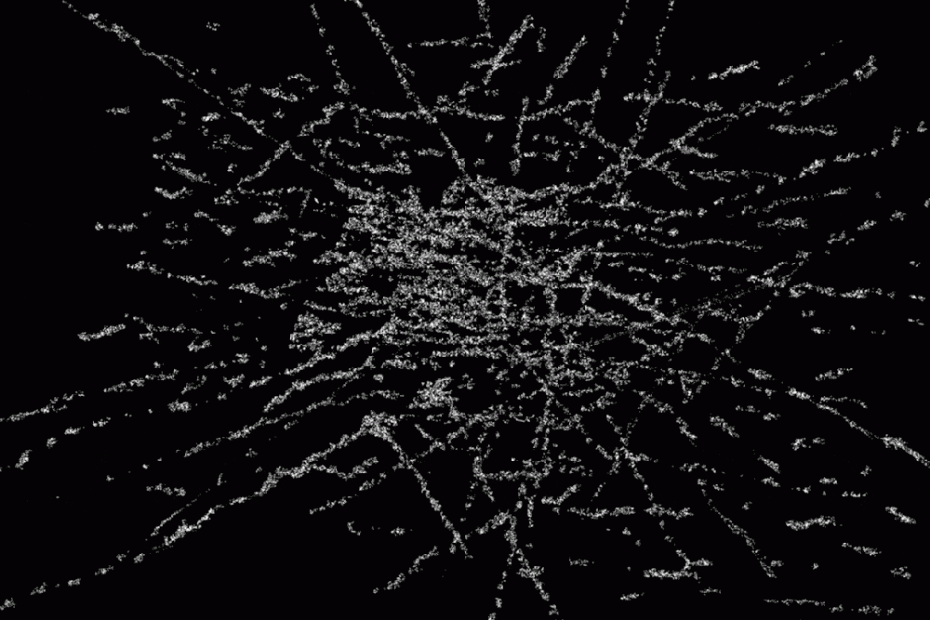
Group portrait of all 474 leaked NSA (National Security Agency) documents made public by Edward Snowden in June 2013. All images copyright Eric Corriel, Enter The Machine 3.0.
As I admit that I’m ignorant about this level of digital artistry, please add any description that will increase my understanding.
It might be helpful to think of this project as being situated along a timeline. When most people think of portraits in an art context, they generally think of the paintings of kings, queens and the aristocracy that we’ve all seen in museums. One either had to be royalty or rich to have access to portraiture. With the introduction of the camera, portraiture took its first step in becoming accessible to more and more people. Nowadays, with the ubiquity of the smartphone, virtually all humans have access to portraiture at the tap of a button.
The history of portraiture is one of expansion, encompassing more and more different types of subjects under its umbrella. As our lives become increasingly more intertwined with the digital, and as the digital seemingly is becoming more lifelike with the advent of AI, I believe portraiture will adapt and spread its dominion to encompass digital entities as well. If this is the case, then Enter the Machine is the tip of the spear.
Portrait of America Online 3.0’s SETUP32.EXE, which was sent to hundreds of thousands of American households on CD-ROM throughout the 1990s and kickstarted the adoption of the modern internet.
What do you mean when you say, “Enter The Machine situates itself in between two cultural histories: the centuries-old drive towards the widening definition and accessibility of portraiture and the contemporary need to see more deeply into the digital structures that surround us”?
In a fundamental way, portraiture is about surfacing the inner world of its subject. When we look at portraits, we often ask, what is the artist trying to show us? Which qualities of the subject is the artist trying to render more visible? Portraiture reveals more about the subject than what appears on the surface.
So if we agree on this conceptual approach to portraiture, then I don’t think this project looks so far-fetched. Our digital files also have complex inner worlds lying beneath the surface of their icon, or thumbnail image, or “Quick Look” preview. They also have stories; they’ve traveled far and wide, and some of them have even altered the course of history. There’s a richness to the world of digital entities that I believe is in need of further exploration, and adapting traditional ideas of portraiture is a perfect way to do it.
Group portrait of all 474 leaked NSA (National Security Agency) documents made public by Edward Snowden in
June 2013.
You ask the following on your website: “Will the democratization of portraiture also extend to digital entities? If so, what would that look like?” What’s the answer?
The answer is yes! It looks like the images that appear in this article and on the website, enterthemachine.io.
Portrait of the first ebook, The Declaration of Independence, by Thomas Jefferson; digitized by Michael S. Hart for Project Gutenberg in 1971.
How did this concept emerge? What are your influences, goals and outcomes?
The story begins in 2012 when I took a failed hard drive out of my Mac and, staring at it, thought that inside the metal casing lay a self-contained world, stacked and compacted, distinctly structured, and crazily complex—if only we could see it …
But I didn’t start working on Enter The Machine 1.0 until 2015. At the time, I was supposed to create a video installation in the windows of a gallery on the Bowery, but when scaffolding went up in front of the windows, the gallery owners suggested I do a show inside instead. That’s when the idea from 2012 came rushing back, and the rest is history.
I’m influenced by what I’d call the second wave of digital artists. Not the pioneers like Vera Molnar, Fredier Nake, and Manfred Mohr, who were working in the ’60s and ’70s, but more like Jared Tarbell, Robert Hodgin and Casey Raes, who were working in the early 2000s. There’s a kind of “concentrated complexity” that one finds in those works that has clearly influenced me.
Regarding goals, I’ll just say, to provide a new way of seeing and understanding digital entities.
Portrait of Tim Berners-Lee’s Information Management: A Proposal, published in March 1989, which laid the theoretical foundations for the modern internet.
Again, I’ll quote you: “The first work in the Enter The Machine 2.0 series was shown in 2017 at the Van Loon Museum in Amsterdam. The museum provided a high-resolution image of The Marriage of Willem van Loon with Margaretha Bas by Jan Miense Molenaer for encoding. Sound composition by Krista Dragomer.” What is the principal innovation in this and subsequent works created for your project?
For any artwork in a museum, there are two things: the physical piece and its digital representation, i.e., the JPG. In this day and age, we often see the latter and, without thinking, believe we’ve seen the former. The idea behind The Marriage of Willem van Loon with Margaretha Bas by Jan Miense Molenaer is to make its digital encoding explicit by showing the bits behind the image on the image.
Portraits on in situ on display.
Where do you plan on going with Enter The Machine, and how will you get there?
I’ve just released Enter The Machine 3.0 (https://v3.enterthemachine.io), the first portrait studio for digital entities. So first thing’s first–I’ll be making new portraits of digital files, folders, apps and systems. I’ll be doing more portraits of “famous” digital entities–those that have played a significant role shaping our culture–and I’ll also be accepting commissions (https://v3.enterthemachine.io/commissions) for portraits of people’s files. As for Enter The Machine 4.0, we’ll just have to wait and see!
Portrait of Barack Obama’s official presidential portrait—the first to be taken with a digital camera. Photographed by Pete Souza.
The post The Daily Heller: What is Portraiture in Digital Space? appeared first on PRINT Magazine.