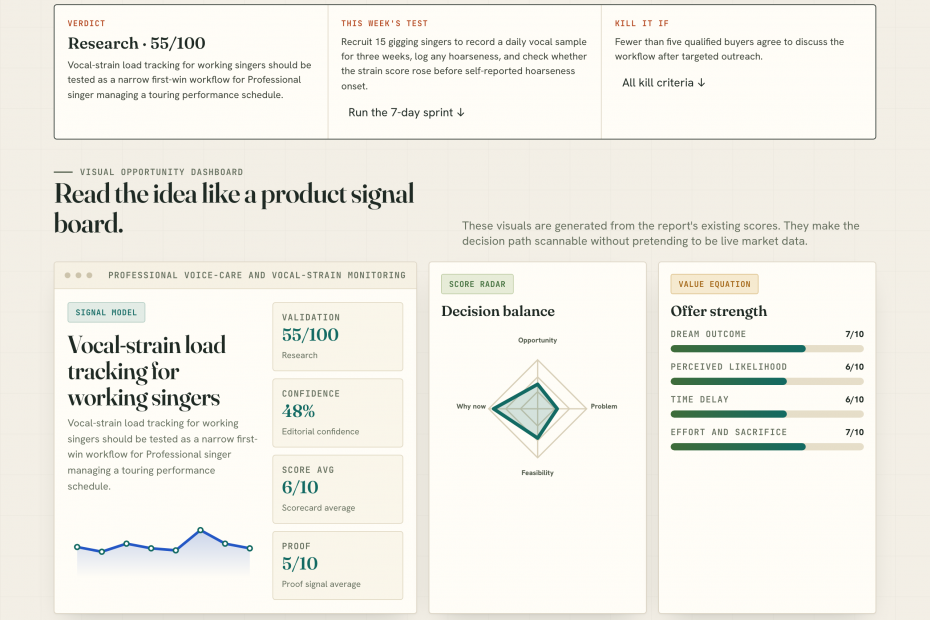
Full opportunity report: Vocal-strain load tracking for working singers on IdeaNavigator AI — validation score, market gap, and execution plan.
TL;DR
Researchers are testing a vocal load tracking app designed for touring singers. The tool records post-performance samples to detect early signs of vocal strain, offering an early warning system. Validation is ongoing with a small group of gigging singers.
A new vocal load tracking application is being tested with professional touring singers to help prevent vocal injuries by detecting early signs of strain after performances. The app records short vocal samples, scores cumulative strain, and flags tone shifts that could indicate impending hoarseness, offering a potential tool for self-managed vocal health.
The proposed system leverages on-device audio analysis to evaluate vocal characteristics immediately after performances. It aims to provide singers with real-time feedback on their vocal health by comparing current strain levels against their personal baseline, which could help identify early signs of overuse before symptoms like hoarseness develop.
According to developers, the MVP involves singers recording a brief vocal sample following each gig, which the app then analyzes to generate a strain score. If the score exceeds certain thresholds or shows tone shifts associated with previous hoarseness cases, the app alerts the user and suggests warm-up routines or rest. The goal is to enable self-management and reduce the risk of vocal injury during busy touring schedules.
Initial validation involves recruiting 15 gigging singers to record daily samples over three weeks, tracking any self-reported hoarseness, and analyzing whether the strain scores rose beforehand. The approach is designed to be accessible and scalable, targeting voice professionals who often self-manage their schedules without immediate access to vocal coaches.
Potential Impact on Vocal Health Management
If successful, this technology could significantly reduce the incidence of vocal injuries among professional singers, especially those on demanding touring schedules. Early detection of strain could lead to better self-care, fewer cancellations, and longer vocal careers. It also offers a new tool for voice professionals to monitor their health independently, aligning with the growing trend of self-managed gig economy workers.
Advances in Audio Analysis Enable Vocal Monitoring
Recent developments in on-device audio analysis have made it feasible to evaluate vocal characteristics quickly and accurately. This progress coincides with increased self-management among gig performers, who often lack immediate access to voice specialists. The idea of using mobile technology to monitor vocal health has been discussed in voice care circles, but practical, user-friendly solutions are only now entering testing phases.
Previous efforts to prevent vocal injuries relied on subjective self-assessment or periodic check-ups. The new app concept aims to provide continuous, objective monitoring, offering early warnings based on measurable vocal parameters. Validation with a small group of singers will determine whether the system can reliably predict hoarseness, a common sign of vocal strain.
“This app could provide singers with real-time feedback on their vocal health, potentially preventing injuries before they happen.”
— an anonymous researcher
Validation Results and Reliability of Strain Detection
It remains unclear whether the app’s scoring system can reliably predict hoarseness or injury across diverse voices and performance contexts. The validation study is ongoing, and results are not yet available. Additionally, how well the app performs in real-world conditions with varying acoustic environments is still to be determined.
Next Steps in Testing and Development
Researchers plan to complete the validation study with the 15 singers over the next few weeks, analyzing whether the strain scores consistently precede self-reported hoarseness. If results are promising, developers will refine the algorithm and consider larger-scale testing before potential commercial release. Further integration with coaching and health management tools may also be explored.
Key Questions
How does the app analyze vocal strain?
The app records a short vocal sample after each performance and uses audio analysis algorithms to evaluate vocal characteristics such as tone stability and frequency shifts, generating a strain score based on these parameters.
Can this app prevent vocal injuries?
If validated successfully, the app could help singers identify early signs of strain, allowing them to take preventive measures such as resting or warming up, thereby reducing injury risk.
Is this app suitable for all singers?
The initial testing focuses on professional touring singers, but future versions may be adapted for voice teachers, amateur singers, and other voice-heavy workers.
When will the app be available to the public?
The development is in early testing stages; a commercial release depends on validation outcomes and further development, which could take several months.
What makes this technology different from traditional vocal health advice?
This app offers real-time, objective monitoring based on audio analysis, providing personalized feedback rather than relying solely on subjective self-assessment or periodic check-ups.
Source: IdeaNavigator AI