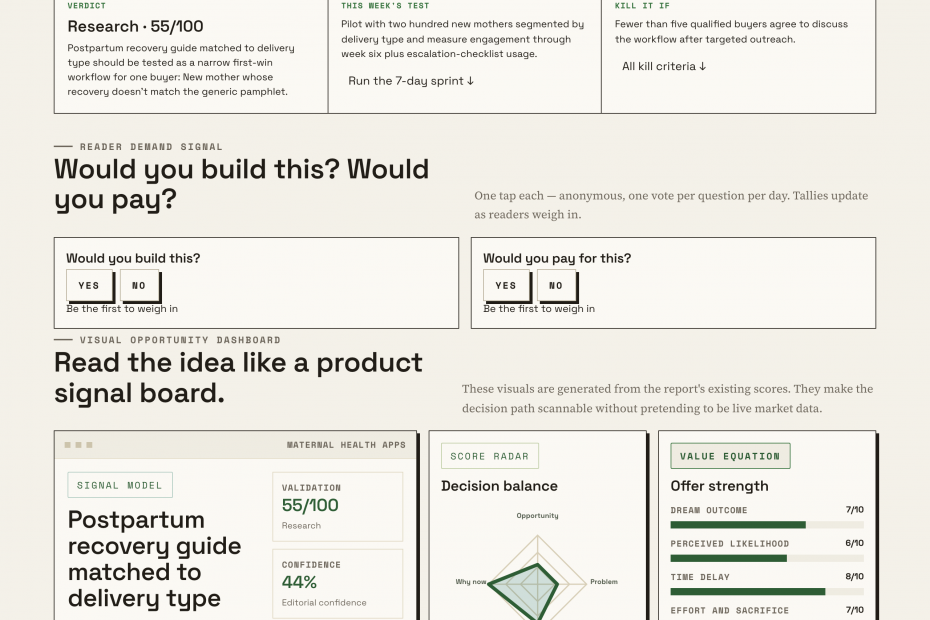
Full opportunity report: What To Look For In A Delivery-Specific Postpartum Recovery Guide on IdeaNavigator AI — validation score, market gap, and execution plan.
TL;DR
An IdeaNavigator AI proposal describes a postpartum recovery guide tailored to delivery details, including complications and interventions. It is a product concept, not a tested clinical tool; its usefulness, safety, and effects on care have not been established.
IdeaNavigator AI’s proposal describes a postpartum recovery guide that would adjust its advice to a mother’s delivery type, interventions and complications, addressing a gap it identifies in generic discharge materials. The proposal is an early product concept, not a clinical guideline or a validated care tool, and no pilot findings are available.
According to the IdeaNavigator AI concept, the proposed guide would begin with an intake covering mode of delivery, interventions, complications and feeding. It would then provide week-by-week recovery expectations matched to that profile, checklists of warning signs, and a preparation summary for the six-week postpartum visit. The concept names examples such as an unplanned C-section, a fourth-degree tear and hemorrhage, situations that can involve different recovery needs.
IdeaNavigator AI frames the idea around mothers whose recovery may not feel represented by a standard pamphlet. The proposal says people may turn to online searches late at night when they are unsure whether a symptom is expected. It provides no evidence about how often that occurs, what information current discharge materials contain, or whether a tailored guide would change health outcomes.
The proposal suggests two possible revenue routes: a consumer subscription and licensing the guide to hospitals as patient education. It identifies a pilot with 200 new mothers, grouped by delivery type, as a possible validation step, tracking engagement through week six and use of escalation checklists. The concept names no participating hospitals, study protocol, funding, timeline or results.
Tailored Guidance Could Fill a Discharge Gap
The IdeaNavigator AI proposal rests on the premise that recovery varies with delivery type and complications, so a single set of expectations may not answer every patient’s questions. A guide organized around a person’s clinical history could make relevant information easier to find and help prepare questions for follow-up. That is the product’s proposed value; it has not yet been demonstrated.
Warning-sign information carries particular weight because a digital guide could influence whether someone seeks care or waits. Any real-world version would need clinically reviewed content, clear direction to contact a clinician or emergency services when appropriate, and safeguards against presenting general information as a diagnosis. The proposal does not describe those review or safety processes.
The Proposal and Its Care Setting
IdeaNavigator AI frames the concept against a wider call for more individualized postpartum follow-up, but its proposal does not identify particular guidelines, dates or issuing organizations. Readers therefore cannot use this proposal alone to establish what current clinical recommendations require. Its central observation is that the product landscape may treat delivery as one broad category even though recovery can differ substantially.
The suggested six-week visit is the guide’s organizing milestone, with weekly expectations and a visit-preparation summary intended to support patients between discharge and follow-up. The proposal does not say whether the guide would be reviewed by a clinician, integrated with a hospital record, or updated as a patient’s symptoms change.
Clinical Review and Pilot Details Remain Open
IdeaNavigator AI reports no clinical trial, user study, safety evaluation or deployment. The proposed 200-person pilot is a plan for validation, not evidence that the guide improves recovery or care. The concept does not describe its recruitment method, participant demographics, comparison group, measures or oversight.
The proposal also leaves open who would write and maintain the medical content, how the guide would handle overlapping conditions, or what thresholds would trigger an escalation recommendation. It does not explain subscription pricing, hospital licensing terms, privacy protections for sensitive health information, or whether access would be free through participating providers.
A Pilot Would Test Use Through Week Six
IdeaNavigator AI identifies a possible test with 200 mothers segmented by delivery type, measuring engagement through the sixth postpartum week alongside use of escalation checklists. Results could show whether patients use the material across different recovery profiles, but engagement alone would not establish clinical accuracy or improved outcomes.
Further details would be needed to assess the proposal: a pilot protocol, clinical review process, safety procedures, privacy approach and a plan for evaluating whether the guidance helps patients get appropriate care. The proposal gives no launch date or pilot completion date.
Source: IdeaNavigator AI
Key Questions
Is this postpartum guide already available?
The IdeaNavigator AI proposal gives no launch date and does not say that the guide is available. It describes a product concept and a possible pilot.
What would the guide tailor?
According to the proposal, its intake would capture delivery mode, interventions, complications and feeding, then use those details to shape week-by-week expectations, warning-sign checklists and preparation for the six-week visit.
Has the guide been shown to improve recovery?
The proposal provides no study results. Its suggested pilot would measure engagement and checklist use; those measures alone would not prove improved health outcomes.
Who would review the medical advice?
The proposal does not identify a clinical review team or explain how medical content would be checked and maintained.
Source: IdeaNavigator AI